

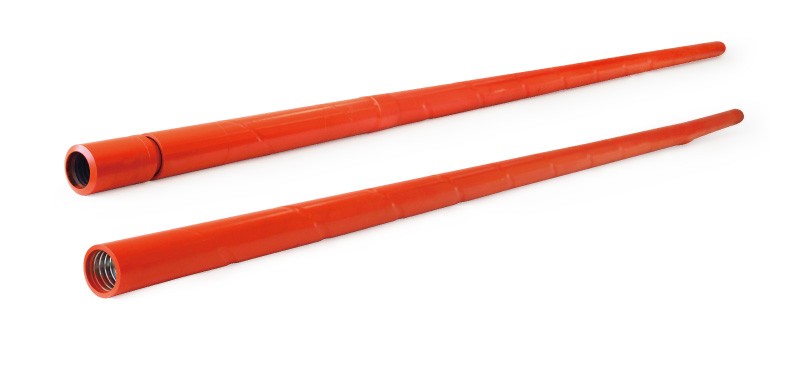
Product Name: Non-magnetic Screw drill motor
Product Model:
Place of Origin: Shanxi, China
Screw Motor (Screw Drill)
A screw motor, also known as a screw drill, is a type of bottom hole motor specifically designed for use in oil and gas drilling as well as geological exploration. It serves as a downhole powered drilling tool that converts the energy from high-pressure drilling fluid into mechanical energy to drive the drill bit for drilling operations.
Components:
Bypass Valve Assembly: Positioned at the top of the screw motor, its primary function is to automatically open when the pump stops supplying fluid, allowing the drilling fluid to bypass through dedicated ports. This prevents damage to the drilling equipment caused by pressure differentials.
Motor Assembly (Stator and Rotor):
Stator: A housing featuring helical chambers, typically lined with rubber to ensure sealing performance.
Rotor: A metal helix slightly different in shape from the internal cavity of the stator, installed inside it. The rotor forms sealed chambers within the stator through tight fitting, enabling efficient operation.
Universal Shaft Assembly: Connects the rotor to the drive shaft, converting the rotor’s eccentric motion into concentric rotation of the drive shaft. It is designed to withstand significant radial and axial loads.
Drive Shaft Assembly: Located at the bottom of the screw motor, directly connected to the drill bit, this assembly is responsible for transferring torque to the drill bit.
Working Principle
The working principle of the screw motor is based on a positive displacement mechanism similar to that of a volumetric pump. When high-pressure drilling fluid is pumped into the screw motor, it enters the sealed chambers formed between the stator and rotor. As more drilling fluid flows in, these chambers sequentially fill along the length of the rotor, pushing the rotor into an eccentric rotational movement relative to the stator. This eccentric rotation is then converted into concentric rotation of the drive shaft via the universal shaft assembly, thus driving the drill bit for drilling operations.
An increase in the flow rate of the pumped drilling fluid results in a corresponding increase in the output torque and speed of the screw motor, and vice versa.
Thanks to its unique design, the screw motor can deliver high torque at relatively low speeds, making it ideal for directional drilling, horizontal drilling, and other operations requiring precise control over the borehole trajectory.
Overall, through the coordinated functioning of its components, the screw motor effectively transforms fluid energy into mechanical energy, serving as an essential tool in modern drilling technology.
|
Motor model |
Outer diameter |
Bit size |
Rotor:sator |
stages |
Flow rate(lpm) |
rpm |
Output Torque |
Maximum drilling pressure |
|
5LZ60×7.0-5 |
60 |
79-111 |
5:6 |
5 |
118-272 |
268-617 |
258 |
16 |
|
5LZ65×7.0-5 |
65 |
79-111 |
5:6 |
5 |
127-292 |
256-588 |
283 |
20 |
|
5LZ73×7.0-5 |
73 |
95-121 |
5:6 |
5 |
162-578 |
121-432 |
766 |
25 |
|
7LZ79×7.0-4 |
79 |
95-121 |
7:8 |
4 |
175-625 |
134-479 |
790 |
25 |
|
7LZ89×7.0-4 |
89 |
114-149 |
7:8 |
4 |
255-766 |
108-325 |
1134 |
35 |
|
9LZ95×7.0-4 |
95 |
118-149 |
9:10 |
4 |
460-928 |
139-280 |
1426 |
55 |
The fully non-magnetic screw drill utilizes a monolithic forging process with non-magnetic steel, truly achieving a magnetization-free lifecycle for the drilling tool. This product is our patented offering. Through modular integrated innovation, we directly connect the probe system to the screw drill, shortening the distance between the probe and the drill bit by 1.5 meters. This controls signal attenuation, accelerates data transmission response speed and accuracy. This means drill operators can capture formation changes in real-time and promptly adjust drilling